 Skarp
From Royal Debt to Revolution: France, 1787–1792
This course traces how a fiscal emergency became a crisis of sovereignty and ultimately destroyed the French monarchy. Through constitutional choices, primary-source evidence, and connected decision points, learners will examine why reform repeatedly failed and how war, popular action, and political distrust drove the Revolution toward August 1792.
The first lecture plays free — no account needed.
What you'll learn
- Students will be able to use a simplified royal budget and tax map to explain why additional borrowing or minor spending cuts could not resolve the monarchy's combined fiscal and political crisis.
- Students will be able to compare voting by order with voting by head and determine why the Third Estate's procedural demands challenged the constitutional foundations of royal government.
- Students will be able to construct a causal chain linking royal troop movements, urban insurrection, rural unrest, and the Assembly's qualified abolition of privilege.
- Students will be able to evaluate a revolutionary policy against the Declaration's principles and identify how property, gender, religion, and colonial status limited the application of universal rights.
- Students will be able to assess whether the Constitution of 1791 created a workable balance of powers by testing its royal veto and executive arrangements against the crisis of confidence after Varennes.
- Students will be able to weigh the competing decisions of the king, Legislative Assembly, Paris sections, and foreign powers to explain why the monarchy was suspended on August 10, 1792.
Prerequisites
- Royal debt and budget deficits
- Tax exemptions and unequal burdens
- Institutional resistance
- The National Assembly
- The Tennis Court Oath
- National sovereignty
Course Content
6 modules · 1h 10m total
A State That Could Not Tax: The Fiscal Crisis
Students will be able to use a simplified royal budget and tax map to explain why additional borrowing or minor spending cuts could not resolve the monarchy's combined fiscal and political crisis.
Who Speaks for France? From Estates-General to National Assembly
Students will be able to compare voting by order with voting by head and determine why the Third Estate's procedural demands challenged the constitutional foundations of royal government.
When the Streets and Countryside Entered Politics
Students will be able to construct a causal chain linking royal troop movements, urban insurrection, rural unrest, and the Assembly's qualified abolition of privilege.
Rebuilding France: Rights, Property, and the Boundaries of Citizenship
Students will be able to evaluate a revolutionary policy against the Declaration's principles and identify how property, gender, religion, and colonial status limited the application of universal rights.
A Constitution Without Trust: The Monarchy of 1791
Students will be able to assess whether the Constitution of 1791 created a workable balance of powers by testing its royal veto and executive arrangements against the crisis of confidence after Varennes.
War, Veto, Insurrection: The Fall of the Monarchy
Students will be able to weigh the competing decisions of the king, Legislative Assembly, Paris sections, and foreign powers to explain why the monarchy was suspended on August 10, 1792.
Read the Textbook
Read every chapter for free, right here in your browser.
The central problem
France's monarchy did not simply spend more than it received in one bad year. It faced a fiscal-political crisis: it needed dependable revenue, but its tax system was unequal, fragmented, costly to collect, and difficult to reform.
Use this distinction: A budget deficit is an annual shortfall: expenses exceed receipts. A debt crisis arises when lenders doubt whether future receipts can cover interest and repayment. A fiscal-political crisis arises when the state cannot credibly change taxation because powerful institutions and groups can resist it.
Study Flashcards
Key concepts from this course as flashcard pairs.
A State That Could Not Tax: The Fiscal Crisis
Budget deficit
An annual shortfall in which payments exceed receipts.
Public credit
Lenders' confidence that a government can honor debt through credible future revenue.
Liquidity
Having enough cash or borrowing capacity to make payments now.
Solvency
Having a sustainable long-term capacity to meet obligations.
Structural fiscal crisis
A crisis rooted in the revenue system and political capacity to change it, not merely one year's overspending.
Who Speaks for France? From Estates-General to National Assembly
Estate or order
A legally recognized corporate group in the Old Regime: clergy, nobility, or Third Estate.
Cahier de doléances
A grievance register prepared during the 1789 electoral process, recording requests and complaints from a particular community or order.
Voting by order
Each estate casts one collective vote. Three orders mean three votes, regardless of the number of deputies in each.
Voting by head
Each deputy casts an individual vote. Numerical representation and cross-order alliances can affect the result.
Common verification
A joint examination of deputies' credentials. In 1789, it became a claim that representatives should form one assembly.
Constituent authority
The claimed power to establish or remake the constitutional rules of government.
When the Streets and Countryside Entered Politics
Popular sovereignty in action
Collective political action by ordinary people claiming to defend or enact the nation's interests, as Parisians did in July 1789.
Great Fear
A wave of rural alarm, arming, and unrest in late July and early August 1789, shaped by rumors and local grievances.
Terrier
A record of seigneurial rights and obligations. Such documents could be targeted because they supported claims to dues.
Feudal dues
Payments, services, or obligations associated with seigneurial rights. The August Decrees did not treat all of them identically.
Redemption
The buyout of a right or due. Under the August Decrees, many dues deemed redeemable could continue until bought out.
Rebuilding France: Rights, Property, and the Boundaries of Citizenship
Active citizen
A man who met legal qualifications for participation in primary electoral assemblies under the revolutionary constitutional system.
Passive citizen
A person with civil protections but without the political rights reserved to active citizens.
Nationalization
Transfer or placement of property under the Nation's control for a publicly defined purpose.
Civil Constitution of the Clergy
The 1790 reorganization of the Catholic clergy under the revolutionary state, including elected clergy and redrawn dioceses.
Institutional autonomy
An organization's capacity to govern its own affairs without being directed by the state.
Political exclusion
A rule that denies a group participation in making or choosing the authorities that make law.
A Constitution Without Trust: The Monarchy of 1791
Suspensive veto
A royal refusal that delayed a legislative decree rather than permanently defeating it. Under the 1791 Constitution, repeated approval by two later legislatures could override it.
Separation of powers
The allocation of legislative, executive, and judicial functions to distinct institutions so that no single body controls all of them.
Ministerial responsibility
The rule that ministers could be held legally accountable for official acts, even when those acts followed a royal order.
Flight to Varennes
Louis XVI's attempted departure from revolutionary France on June 20-21, 1791, which damaged confidence in his commitment to constitutional monarchy.
Champ de Mars crisis
The July 17, 1791 confrontation around a petition demanding the king's removal, ending in deadly National Guard fire and a deeper political split.
War, Veto, Insurrection: The Fall of the Monarchy
Suspensive veto
The king's constitutional power to refuse consent to a decree temporarily; it could not permanently block the same decree after repeated approval by later legislatures.
Fédérés
Provincial National Guards who came to Paris; their presence increased the political and military pressure on the monarchy.
Paris sections
Local political assemblies in Paris that became centers of petitioning, mobilization, and eventually insurrection.
Brunswick Manifesto
A declaration issued from Koblenz on July 25, 1792, in the name of the Austro-Prussian commander, threatening Paris if the royal family were harmed.
Suspension
The August 10 removal of Louis XVI from exercising royal power. It was not yet the formal abolition of royalty.
More in History
See all →
The Origin Story of the English Alphabet
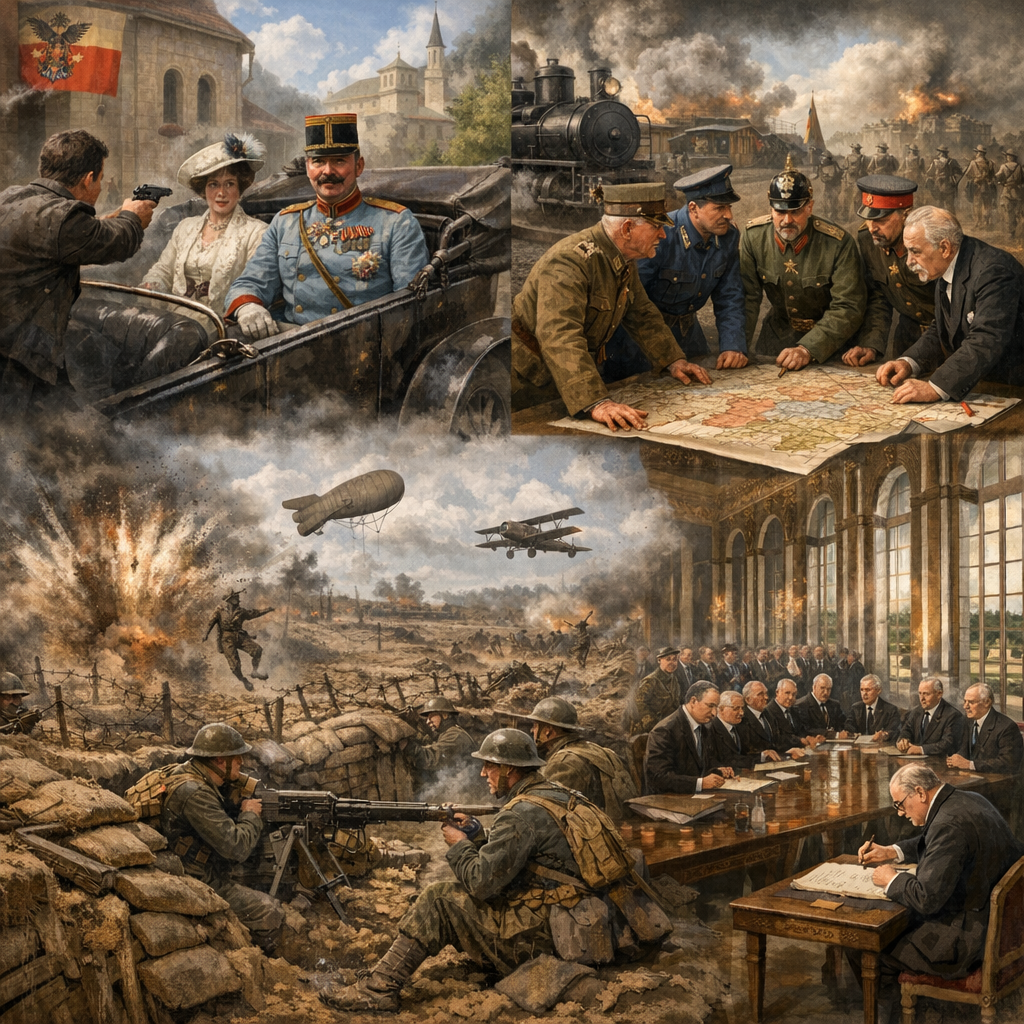
Första världskriget för åk 8: Från skottet i Sarajevo till Versaillesfreden

Yhdysvaltain sisällissota: syyt, kulku ja seuraukset