 Skarp
Skarp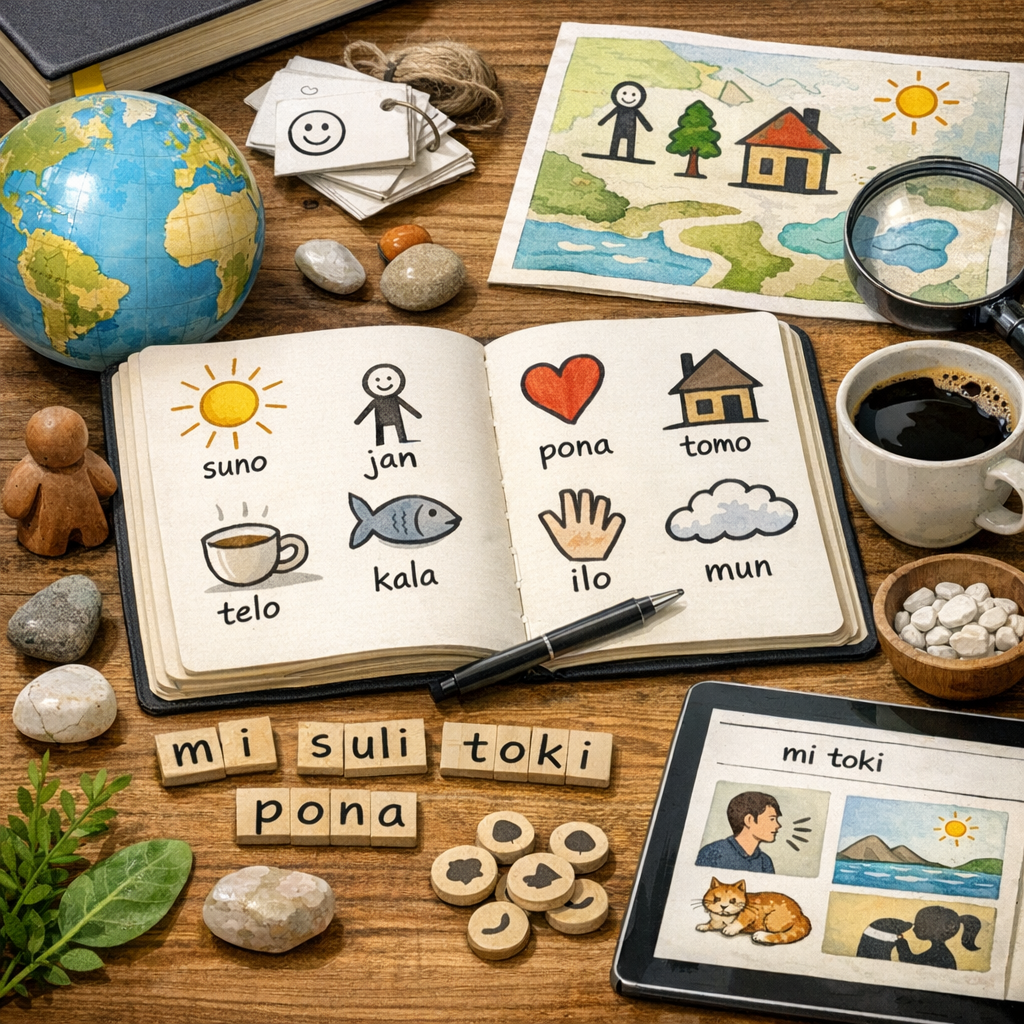
Exploring Toki Pona: A Minimalist Language in Practice
This course introduces you to Toki Pona, a minimalist constructed language with around 120–140 core words. You will learn its sounds, basic grammar, and essential vocabulary while exploring how such a small system can express rich ideas and shape how you think.
The first lecture plays free — no account needed.
What you'll learn
- Students will be able to explain what Toki Pona is and why it was created.
- Students will understand the idea of expressing many meanings with a very small vocabulary.
- Students will be able to describe at least three ways Toki Pona is used today (e.g., conversation, art, online communities).
- Students will be able to correctly pronounce core Toki Pona sounds and syllables.
- Students will understand how Toki Pona words are formed and spelled.
- Students will be able to read and say simple Toki Pona words from a word list.
- Students will be able to recognize and use 15–20 high‑frequency Toki Pona words.
- Students will understand how adjectives follow nouns to modify them.
- Students will be able to create simple descriptive sentences about people and objects.
- Students will be able to identify the main particles that structure Toki Pona sentences.
Prerequisites
- Awareness of what Toki Pona is and its minimalist nature
- Basic understanding of Toki Pona pronunciation and spelling
- Core vocabulary and simple descriptive sentences in Toki Pona
- Basic sentence structure with li and e
- Familiarity with a range of core content words
- Comfort with simple sentences and compounds in Toki Pona
Course Content
9 modules · 1h 55m total
What Is Toki Pona? Minimalism, Origins, and Community
Get an overview of Toki Pona: where it comes from, why it was created, and what makes it a uniquely minimalist language with around 120–140 core words.
Sounds and Spelling: Pronouncing Toki Pona
Learn the 14 phonemes, simple syllable structure, and spelling rules of Toki Pona so you can read and pronounce words confidently.
First Words: People, Things, and Simple Descriptions
Build your first Toki Pona vocabulary: people, objects, basic qualities, and very simple sentences like "I am a good person" or "This water is bad."
Building Sentences: Particles, Subjects, and Objects
Discover how Toki Pona sentences work using key particles like li, e, and la to show subjects, verbs, and objects.
Saying More With Less: Compounds and Polysemy
Learn how Toki Pona expresses complex ideas with word combinations, and how each word can cover several related meanings depending on context.
Time, Space, and Quantity With a Tiny Toolkit
Explore how Toki Pona talks about time, movement, and amount using a very small set of words and a minimalist number system.
Everyday Conversations: Feelings, Needs, and Social Interactions
Practice short dialogues in Toki Pona about feelings, preferences, needs, and simple social situations.
Seeing Toki Pona: Introduction to sitelen pona and Other Scripts
Discover how Toki Pona can be written not only with the Latin alphabet but also with sitelen pona and other community‑created scripts, and practice reading a few basic glyphs.
Toki Pona, Thought, and Change: Philosophy and Modern Use
Reflect on how Toki Pona connects to ideas about language and thought, and how its vocabulary and usage continue to evolve in today’s online communities.
Read the Textbook
Read every chapter for free, right here in your browser.
In this step, you will learn useful Toki Pona words to talk about the language itself, its simplicity, and the people who use it.
In Toki Pona, many grammar patterns are simple and minimal. To talk about what Toki Pona is like, we use a basic sentence pattern and adjective-like words. Basic descriptive sentences: X li Y
To say "X is Y" in Toki Pona, you often use: Pattern: X li Y There is usually no separate word for "is".
More in Languages
See all →
French Pronunciation and Conversation for Beginners

Survival Travel Phrases in Spanish, French, and Mandarin

Conversational Swahili for Everyday Situations

Everyday Conversational Arabic: Practical Phrases for Real Life

Everyday Mandarin: Practical Conversational Chinese