 Skarp
Skarp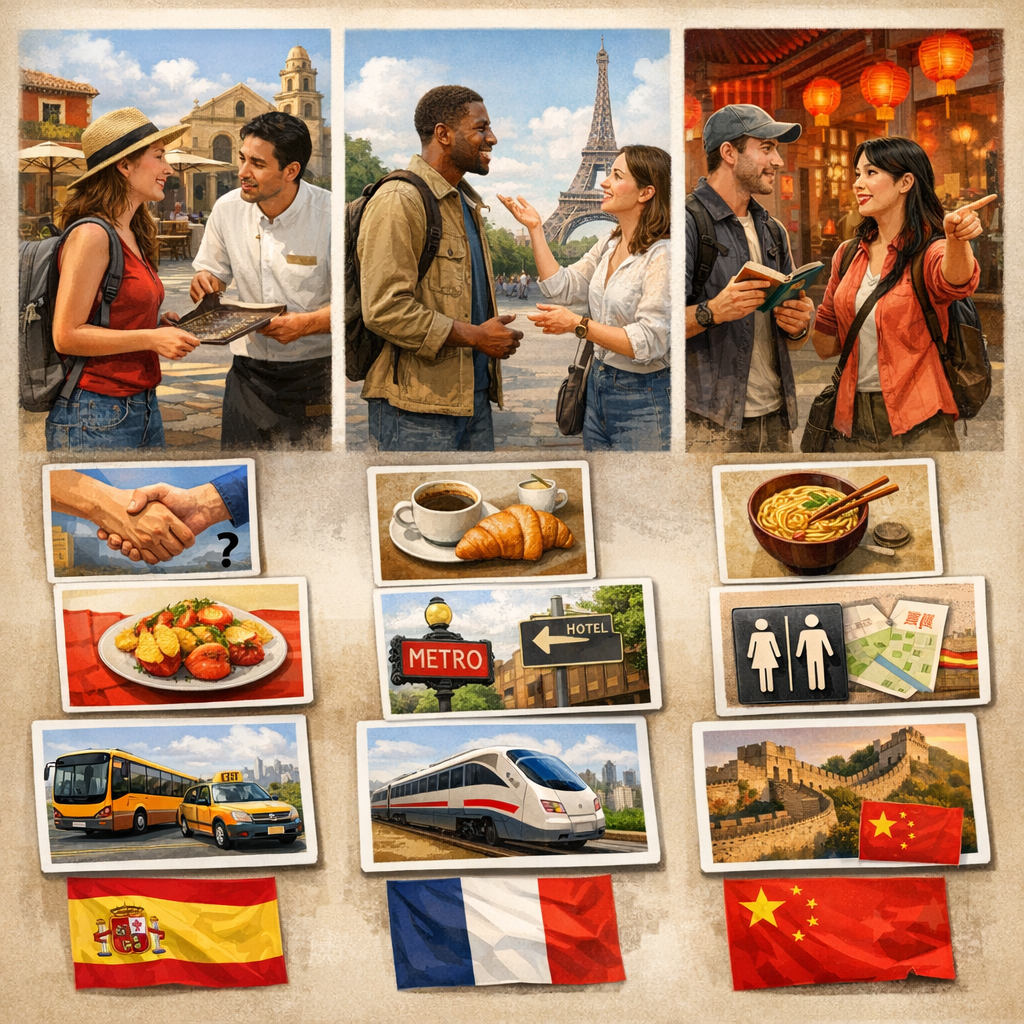
Survival Travel Phrases in Spanish, French, and Mandarin
Learn the essential phrases and etiquette you need to travel confidently in Spanish-, French-, and Mandarin-speaking regions. This course focuses on high‑frequency expressions for real situations like getting around, ordering food, asking for help, and being polite and culturally respectful.
The first lecture plays free — no account needed.
What you'll learn
- Students will be able to list at least five essential phrase categories needed for typical trips.
- Students will be able to identify 3–5 personal travel situations and the types of phrases required for each.
- Students will understand the importance of learning polite greetings and basic requests in all three languages.
- Students will be able to pronounce at least 5 core words (e.g., hello, please, thank you) in each language in a way that is understandable to natives.
- Students will understand how Mandarin tones change meaning and will practice tones on a small set of high‑frequency words.
- Students will be able to use simple strategies (slowing down, repeating) to make themselves clearer when speaking.
- Students will be able to use appropriate greetings and farewells in Spanish, French, and Mandarin in common settings (shops, restaurants, hotels).
- Students will be able to say please, thank you, excuse me, and sorry in all three languages and know when to use them.
- Students will understand key etiquette points, such as greeting staff when entering a French shop or using polite forms with service workers.
- Students will be able to ask for directions to a specific place and understand simple responses in each language.
Prerequisites
- Core phrase categories from Module 1
- Pronunciation basics from Module 2
- Polite greetings and courtesies from Module 3
- Core politeness phrases from Module 3
- Directions and transport phrases from Module 4
- Foundational travel interaction phrases from Modules 3–6
Course Content
10 modules · 2h 30m total
Getting Oriented: Travel Phrase Essentials Across Three Languages
Overview of the most useful phrase types for travelers and how they map across Spanish, French, and Mandarin. You’ll identify your own travel scenarios and build a mini “must‑have” list that we’ll refine throughout the course.
Sound Basics: Pronouncing Key Phrases Clearly
Learn simple pronunciation rules and hacks for Spanish, French, and Mandarin so your essential phrases are understandable. Focus on stress, rhythm, and a few high‑impact sounds in each language.
Polite Greetings and Everyday Courtesies
Master greetings, farewells, and basic courtesies that locals expect from respectful travelers in Spanish‑, French‑, and Mandarin‑speaking areas.
Getting Around: Directions, Transport, and Navigation
Learn phrases to buy tickets, use public transport, and ask for and understand directions in Spanish, French, and Mandarin.
Food and Drink: Ordering Confidently and Respectfully
Focus on restaurant, café, and street‑food situations. Learn how to read or ask about menus, order politely, handle the bill, and express basic dietary needs.
Staying There: Hotels, Check‑in, and Money Matters
Learn phrases for checking in and out of accommodation, resolving simple issues, and handling money and shopping in local currency.
Emergencies, Health, and Asking for Help
Prepare for less‑ideal situations by learning essential emergency and health‑related phrases, plus how to get help quickly and clearly.
Understanding Replies: Listening Hacks and Clarification Phrases
Even with good phrases, replies can be fast or complex. This module gives you tools to manage real conversations: asking people to repeat, slow down, or switch to simpler language.
Cultural Etiquette and Respectful Traveler Behavior
Tie your language skills to up‑to‑date cultural etiquette in Spanish‑, French‑, and Mandarin‑speaking regions so you avoid common faux pas and show respect.
Personal Phrasebook: Customizing and Practicing for Your Trip
In the final module, you’ll build a compact, personalized phrase set for your own destinations and practice strategies to remember and use them under real travel conditions.
Read the Textbook
Read every chapter for free, right here in your browser.
Here are high‑value travel phrases across three core categories: greetings, help, directions, and food. You will see each phrase in Spanish, French, and Mandarin with pronunciation and an example sentence.
Polite Travel Phrases: Patterns Across Spanish, French, and Mandarin Using polite words: “please” and “thank you”
These are high‑value because they make every request sound more respectful. Spanish usually places “por favor” (please) at the end of the request. Example: Spanish: Una mesa para dos, por favor. English: A table for two, please. French also commonly puts “s’il vous plaît” (please) at the end. Example: French: L’addition, s’il vous plaît. English: The bill, please. Mandarin uses “请 (qǐng)” before the verb, or sometimes is omitted if the tone is already polite. Example: Mandarin: 请给我一张两个人的桌子。 English: Please give me a table for two.
More in Languages
See all →
French Pronunciation and Conversation for Beginners
Conversational Swahili for Everyday Situations
Everyday Conversational Arabic: Practical Phrases for Real Life
Exploring Toki Pona: A Minimalist Language in Practice

Everyday Mandarin: Practical Conversational Chinese